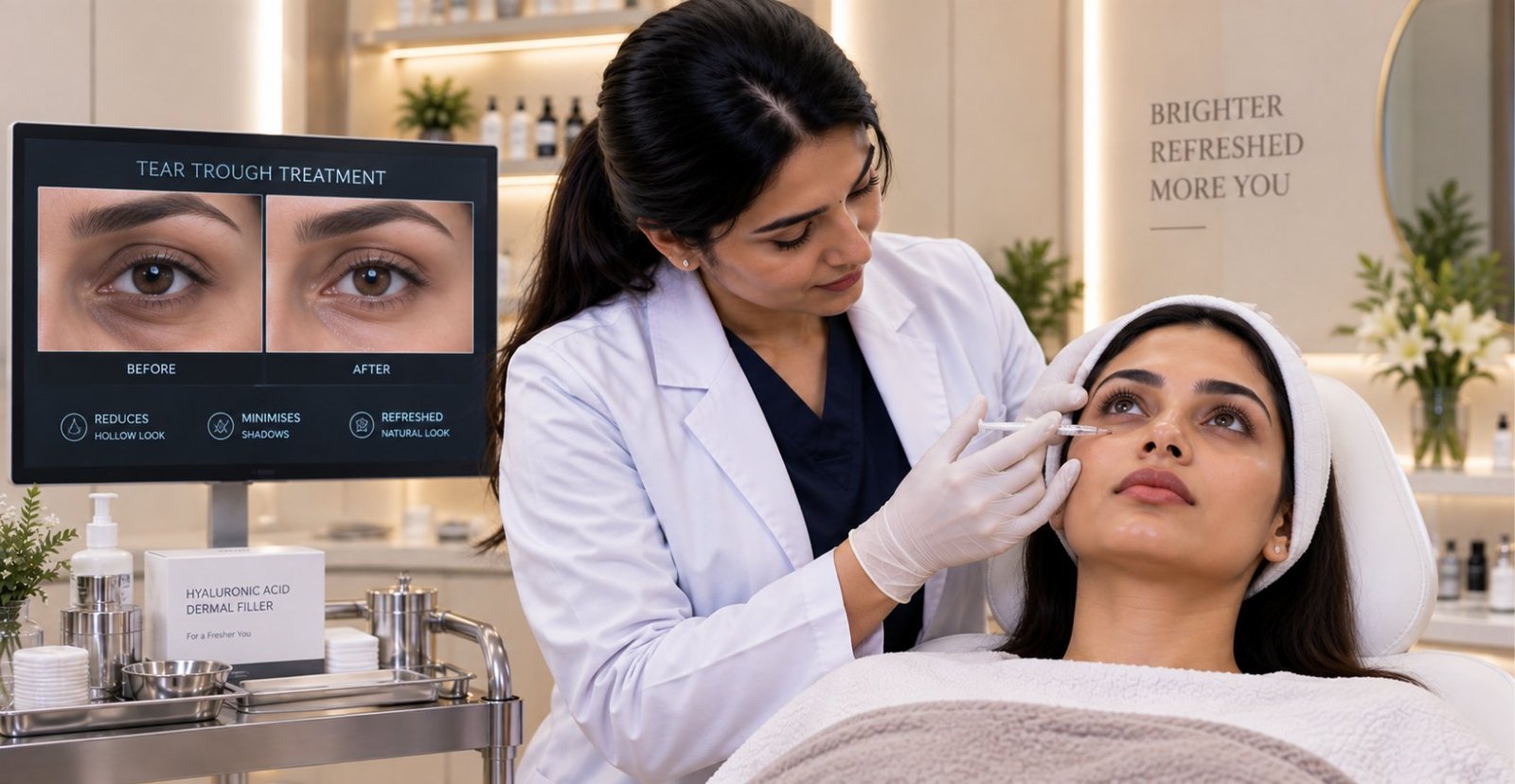
Sleep won’t fix this — but something else can
Tear trough treatment at Skinline, Hyder Nagar, Kukatpally, uses a specialised dermal filler to fill hollows under the eyes and reduce the shadow that makes you look tired, no matter how much you actually slept.
If the concern is a hollow, shadowed look rather than dark pigmentation, this treats the actual cause.
How tear trough treatment works
A softer, lower-viscosity hyaluronic acid filler — formulated specifically for the thin, delicate skin under the eyes — is injected into the tear trough area to fill hollows and reduce the shadow effect caused by volume loss.
This is a genuinely important distinction: tear trough treatment addresses hollowing and shadow, not pigmentation. If your dark circles are caused primarily by excess pigment rather than volume loss, a different treatment altogether — like Q-Switch laser — is likely to help more.
Who should get tear trough treatment
- You have visible hollows or shadowing under the eyes caused by volume loss, not primarily pigmentation
- You look tired even after a full night’s sleep, and it bothers you in photos or on video calls
- You want a non-surgical option before considering eyelid surgery (blepharoplasty)
- You have realistic expectations — conservative, natural-looking correction, not a complete transformation
Who should consider alternatives, or wait
- If pigmentation is your primary concern rather than hollowing, Q-Switch laser or laser toning is likely more effective — your consultation will help identify which is actually driving your dark circles
- Very thin or fragile under-eye skin needs careful assessment before treatment
- Pregnancy or breastfeeding
- Blood-thinning medication — this area bruises more easily than most, so disclosure matters more here than for other filler areas
- Active infection near the treatment area
- Significant, long-standing under-eye bags from fat prolapse may need a surgical opinion rather than filler alone
None of these automatically rule out treatment — an honest assessment of what’s actually causing your under-eye appearance is the point of the consultation.
The benefits: why choose tear trough treatment
Immediate Visible Improvement
Unlike gradual-result treatments, the effect is visible right after treatment, once initial swelling settles.
Minimally Invasive Alternative
For appropriate candidates, a needle-based option before considering eyelid surgery.
Quick Recovery
Far shorter downtime than any surgical alternative.
Reversible
As a hyaluronic acid filler, it can be dissolved if ever needed.
What to expect: the procedure
Topical numbing is applied given the sensitivity of the area. Many providers use a blunt-tipped cannula rather than a sharp needle for this specific treatment, which can reduce bruising and vascular risk in an area with delicate blood vessels close to the surface.
A conservative approach is standard here — less product, checked and built up gradually if needed, rather than one large correction — since overfilling this area risks a bluish discolouration under the skin known as the Tyndall effect.
Preparing for treatment
Avoid blood-thinning medications and supplements where medically possible for about a week beforehand, and avoid alcohol the day before — bruising risk is genuinely higher in this area than in most other filler sites.
Downtime & aftercare
Bruising is more common here than in other filler areas, given how close blood vessels sit to the surface. Mild swelling for a few days is typical. Ice, applied gently, can help manage both in the first 24–48 hours.
What affects the cost of tear trough treatment
Tear trough treatment typically needs less product than larger filler areas like cheeks, but the specialised technique required can affect pricing. Your consultation includes a personalised assessment and quote.
Why Skinline for tear trough treatment
Tear trough is widely considered one of the more technically demanding filler areas — the skin is thin, blood vessels sit close to the surface, and overcorrection is more visible here than almost anywhere else on the face.
At Skinline, this treatment is performed by dermatologists with 10+ years of experience each, using a conservative, cannula-based approach specifically chosen to reduce the risks this area carries.